How Every Taiwanese Receipt Is a Hidden Lottery Ticket
By Rachael Lang
Originally published November 5, 2025
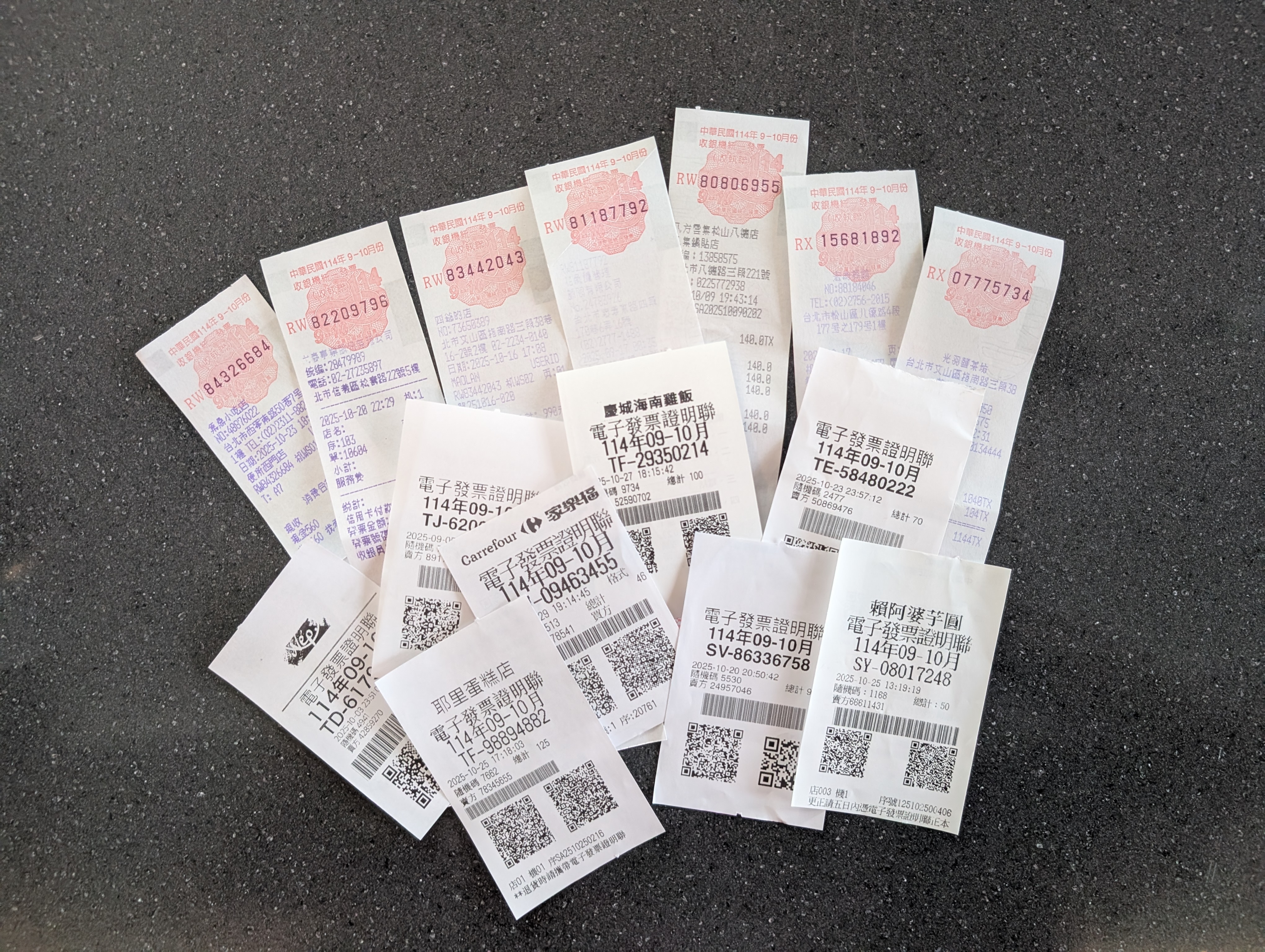
The old (top) and new (bottom) styles of invoices (receipts) in Taiwan.
Hear me read this story here:
Whenever I make a purchase, I always ask for the receipt. Primarily because I’m a data nerd and I have a huge spreadsheet where I keep an itemized list of every purchase I’ve made for the past 4 years (and counting). But, in Taiwan, it’s a no brainer for anyone. For every purchase you make, businesses are legally required to give you a “uniform invoice” (統一發票 tǒngyī fāpiào). This invoice, which I’ll be referring to as a “receipt,” has a unique alphanumeric string that doubles as a lottery number.
The Lottery System
Every two months, the Ministry of Finance announces 5 winning lottery numbers. If you have a receipt with a number that matches the last 3-8 digits, you get a cash prize. The smallest prize starts at NT$200 (around $7 US dollars) and goes all the way up to NT$10 million (around $323,000 US dollars).
Growing up, this was a bi-monthly routine in my household. On the 25th of every odd-numbered month (January, March, May, etc.), my dad and I would sit down with a pile of the receipts we’ve collected. The way he taught me was to sort them into 10 piles based on the last digit of each number. Then, we’d pull up the winning numbers and sift through the corresponding pile to see if any of our numbers matched.
I don’t have the official numbers on the chances of winning, but I can say, as a family of four that made what I would consider to be an “average” amount of purchases, we would win maybe 2-4 of the smallest prizes every two months. In retrospect, it’s not much. But as a kid, that extra NT$200 was a huge deal.
In the past, I used to have to go to the post office to redeem winning receipts. As much as I love postage stamps and the postal system, I don’t frequent the post office particularly often, so this was always a nice excuse to make a visit. I remember the first time after they changed the redemption location, I went all the way to the post office, waited forever in line, just to be redirected to 7-Eleven. Add that to the long list of things you can do at 7-Eleven (more on that in another post).
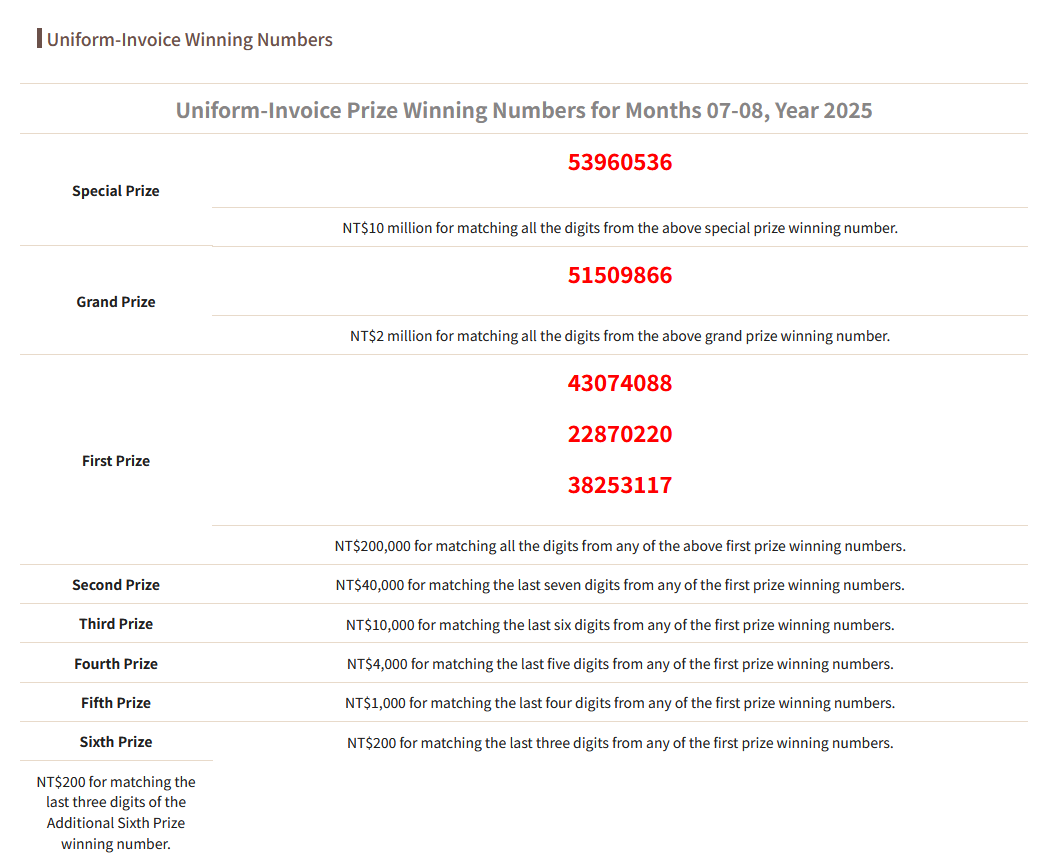
Winning numbers as published by the Ministry of Finance.
Its Origins
I never questioned this system until a non-Taiwanese friend asked me about it. In the moment, I was a little stunned. I knew this wasn’t a worldwide thing, but I’ve also never really thought about why it was a thing at all. As my parents explained to me, the government established a nation-wide standardized process for invoicing to prevent tax evasion by businesses, increase national revenue by promoting consumer spending, and to overall facilitate the process of tax reporting for businesses. So by giving consumers an incentive to ask for their receipt, businesses were encouraged to keep each of their transactions on the books.
While nearly all businesses in Taiwan are legally required to issue consumers a receipt, there are a few exceptions. Small businesses that make less than NT$200,000 (around $6,500 US dollars) a month in sales and certain types of businesses such as soy milk restaurants, buffet restaurants, and bento box restaurants are exempt from providing receipts.
If you’re traveling to Taiwan and don’t expect to stay until the winning numbers are announced, which happens 25 days after the bi-monthly period, consider donating your receipts. Donation boxes are commonly found near cash registers, and any winnings from these receipts are donated to charities.
Going Digital
In recent years, the personal electronic barcode has grown in popularity. Also known as a cloud invoice, this is an account where consumers can digitally store all of their receipts. The best part is, at the end of each cycle, the system automatically checks the numbers for you and any prizes are directly deposited to your bank account. When making a purchase, the cashier prompts you for your 載具, or barcode, which is technically pronounced zài jù but colloquially pronounced zǎi jù. To further streamline the process, you can add your barcode to various methods of payment such as your EasyCard or credit card, and your receipt will automatically be stored without you having to pull up your barcode.
I’m a big fan of the eco-friendly aspect of not printing out additional pieces of paper and convenience of not having to stuff long receipts into my wallet. But I do miss the tradition of sorting, checking, and redeeming receipts. It feels like a uniquely Taiwanese experience.